A couple of days back, I was reading a story where a high school teacher asks her students to write an essay on the opening line of Moby-Dick: 'Call me Ishmael'. Not on Melville's style, not on the voyage or the whale, but on the name itself. Why Ishmael? Why not Bob, or John, or any of the thousands of other names that could have stood in that place?

The next day, I remembered the phrase 'stranger in a strange land', and it pulled me straight into Heinlein's novel of the same name, with its protagonist Valentine Michael Smith. Smith, the plainest of surnames, is a mask of anonymity attached to a figure who was anything but ordinary.

Together, the two encounters left me turning over the question of how much weight a name can carry. A name is never neutral. Ishmael suggests exile, wandering, survival. Smith is just Smith, which is almost the point. Names can be riddles, or half-hidden prophecies, or sometimes just a joke slipped in by the author when you're not looking. Before we know anything of a character's deeds, their name already speaks.

And then I caught myself wondering: what is my own favourite fictional name? I remember listening to Snow Crash during my commutes, grinning every time the narrator announced 'Hiro Protagonist'. The name was so audacious, so perfectly ridiculous, that it made the Chennai traffic around me feel a little less grim. By contrast, when I first encountered Severian in The Book of the New Sun, his name struck me like something unearthed—ancient, weighty, stark. I was reading it whilst my mom lay in the hospital, her sister newly gone, though she never knew. In that silence, Severian's name became more than fiction; it felt like an invocation, heavy with memory and meaning.

Perhaps names are the oldest form of worldbuilding—and the first spell an author casts over us.

Yesterday, I was looking for a topic I knew I’d written about before. But I wasn’t sure if I’d ever published it. So I went searching — through my vault of old drafts, partial posts, abandoned ideas, and half-finished pieces. Organizing that vault has been on my "someday” list for a while now. I keep putting it off.

And then I started reading some of the old drafts. It felt like walking back into a room I used to live in, one I hadn't entered in years. A room that I could navigate with the lights off.

And there it was—the piece I'd been looking for, sitting among all the others I'd abandoned. Which made me wonder: why had I left so many of these unfinished, unpublished?

I’d tell myself I was too busy. That the ideas had gone stale. That I’d moved on. But really, it was a quieter resistance. The kind that doesn’t announce itself but just lingers.

Writing, when it happens in the moment, feels fluid. Like catching a thought before it takes a more concrete shape. Rewriting, though — that’s different. It’s not just editing words. It’s stepping back into the mindset that made them.

That’s when I understood: rewriting isn’t polishing. It’s time travel with consequences.

Reading old writing isn’t just revisiting the words. It’s meeting the person who wrote them. The turns of phrase I thought were clever. The tone I thought struck the right balance. The ideas I believed were solid, maybe even worth sharing.

Sometimes I nod along; sometimes I wince. I catch myself wondering, not “What was I thinking?” — but “Who was I trying to be?

Rewriting asks for more than a better sentence. It asks what’s changed, not just in how I write, but in what I believe.

Some pieces I revisit and think, “Yeah, I still mean this.” Others… I hesitate. The words are fine, but the person behind them feels distant. And that’s the hard part.

Editing, when it’s honest, isn’t just improving. It’s letting go.

I still don’t love going back. Some drafts feel like fossils. Others feel too close, like they’re still breathing. But I’m learning to treat them with care.

Revisiting those moments isn't just about cleaning them up. It's about listening to who I was, so I can respond with who I am now.

Each one holds a version of me — what I noticed, what I believed, what I thought was worth capturing.

So yes, rewriting is time travel with consequences. And one of them is meeting yourself again...

Banner image is Saint Jerome in His Study by Albrecht Dürer.

Today, Max asked me to look at his descriptive writing assignment from school. He didn’t really want help. Not really. He just wanted a quick fix. A skim-and-sign-off.

But he chose the wrong parent.

He flopped beside me on the bed, reluctant. I scanned his draft and saw the usual: a decent attempt, a few bright spots, but mostly scaffolding, words and phrases repeating. It read like someone trying to finish a thing, not someone trying to say something. To show something.

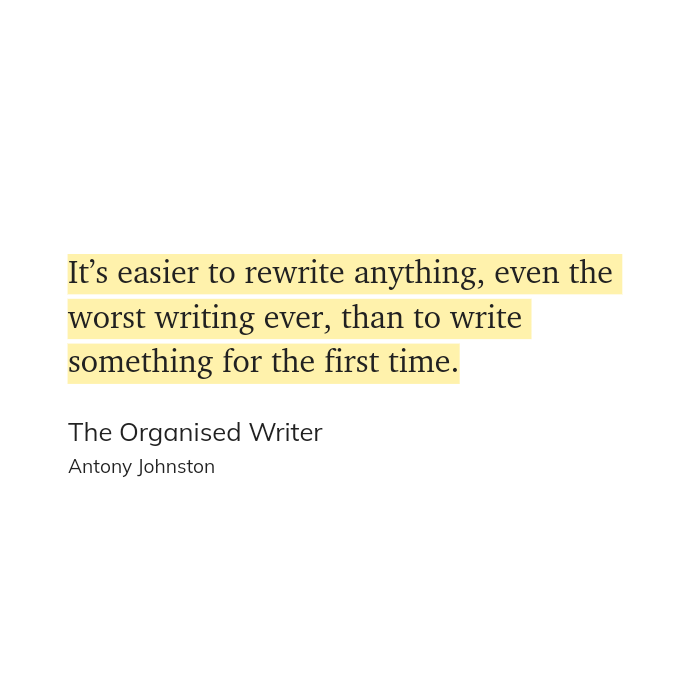
I quipped, “Writing’s easy. Rewriting is the hard part. And it always takes more time than we want it to.”

That didn’t go down well.

Luckily, his book had a passage from Jane Eyre. I asked him to read each sentence out loud and then tell me what that sentence was about and how things were described. His reading was flat, each sentence dropped like a stone. I could tell he wasn’t listening to himself.

“What does that sentence say?” I asked. A shrug. “Something about... the unoccupied bedroom?”

IMG_20250728_202710

Later that evening, I kept thinking about it — not just the parenting part, but the writing part. That kind of descriptive writing — the kind that wraps an image around you, the kind that slows you down — feels rarer these days.

Outside of fiction and the occasional well-written essay or newsletter, you don’t find sentences like that often. Even in long-form spaces like newsletters and blogs — places without social media character limits or Instagram's visual priorities — writers seem to default to shorter, punchier sentences. Shorter paragraphs. Shorter sentences. Quick hits. Fast reads. Sometimes that’s good writing. Often, it’s necessary. But something gets lost in the speed and efficiency of it all — the layering, the rhythm, the careful unfolding of an idea or a scene.

Maybe our attention spans are to blame. Or maybe we’ve been trained by character limits, previews, and scroll-friendly design to read in blinks and fragments.

I found myself wondering if I was witnessing the end of something almost medieval — the notion that a sentence could be a dwelling place rather than a thoroughfare, somewhere you might pause and unpack your thoughts like settling into a favorite armchair, letting clauses accumulate and ideas unfold in their own unhurried time, the way this very sentence insists on taking the scenic route while Max's generation has already moved on to the next notification, the next swipe, the next dopamine hit.

Quick, clean, done.